Midi Awards 2011

This time of year, folks make lists. One list to which Chinese-rock-watchers will be paying special attention is the list drawn up by Midi Productions, hander-outer of the Midi Music Awards. This year marks the third time bricks will be bestowed upon the “top” artists across several categories of yaogun.

Midi, you’ll perhaps recall, began as a music school in 1993, drawing those about to rock from the four corners of the Middle Kingdom. In 2000, the school hosted what was less a festival than a showcase for the bands formed by students. Four years later, it outgrew its campus quad moving into a huge park; by the Olympic year, ‘festival’ and ‘Midi’ were synonyms and the festival expanded to other cities.

I’ll pause here to say that in addition to having played at and worked on several years’ worth of Midi Festivals as well as having worked with Midi on getting several artists on their stages, I have, since 2009, been one of the awards’ hundred-plus judges.

See Rock in China for the 2009 nominees and winners;

The 2010 nominees are here; the winners are here;

Beijing Daze has the 2011 short-list.

The Midi Awards are like the Festival itself: On the surface, all is fantastic. But a look deeper reveals a state of affairs not so much sad as it is disheartening; sad and disheartening in the way that awards generally are, but also in other ways. First, the standard awards narrative: One bemoans the exclusion of the ones one deems worthy of inclusion, damming the spectacle as a result. Until, that is, one’s personal favourites are included, in which case there’s the short-term celebration, sometimes skipped over completely, in the face of the bittersweet experience of the effects of that attention: That morning-after feeling that defines the way many watch their favourite movies, bands, authors cross over in the mainstream. Of course, there’s no risk of pop-co-optation resulting from the Midi Awards, but it’s a feeling with which, I think, anyone who’s felt like they’ve discovered something is familiar.

There is, though, a disheartening element of the awards that goes beyond the standard awards-are-bunk experience. If Midi is yaogun’s judge, Midi needs to be up to snuff, or else yaogun suffers from their mistakes. The short-lists tend to look like the line-ups of just about every Midi Festival since day one: AK47, who won the first Metal award, appeared at all but one of the Midi Festivals; ditto for Miserable Faith, who swept four of the eleven categories at the Awards’ first instalment. Categories are messy as well: XTX and Miserable Faith were nominated, in 2009, for both Rock and Hard Rock band of the year; in 2010, Miserable Faith was nominated in Rock and Hard Rock; 2011 sees Ordnance and Yaksa nominated in Hard Rock and Metal categories. And though I’m jazzed that Omnipotent Youth Society is back on the list again this year, how does a song qualify for Best Song two years’ running?

I was convinced by the argument of influential critic, and one of the eight members of the awards’ Standing Committee that oversees the awards, Hao Fang, that these awards were something Midi ought to do. Movies, he said, weren’t taken seriously until the industry started the Oscars. “Eventually,” he says, “they got respect as a form. After you’ve respected your own form enough, others will too.” But then, the Midi Awards have given many reasons for others to hold off on that respect, the most blatant of which was bestowing upon themselves, in 2010, the award for biggest contribution to Chinese rock. Have they contributed greatly to yaogun? Most definitely. Is handing themselves an award for their work the way to get the rest of the world to notice, care or, well, not point and laugh?

This year, judges were sent upwards of thirty albums, and given thirteen category options. That new categories over the years have opened up – folk, album art – are treated as news that the awards are getting more inclusive. I’d argue they’re like the rush to add stages at the festival: Just because you have them doesn’t mean they represent a collection of artists that should be celebrated. Am I saying that there are no worthy folk acts or album art? No, I am not. But the rush to expansion is made at the expense of examining what one has.

It hasn’t all been bad news: I was personally glad to see Perdel, the Gar and Wang Wei get noinatd in 2009. 2010’s acknowledgement of Omnipotent Youth Society also brought joy. This year, Zhaoze, a mesmorizing post-rock band, and Long Shen Dao (LSD), a reggae/dub collective, are highlights; they stand far above the pack of upwards of thirty albums judges were sent (I found very few worthy of even a full listen). But my picks didn’t make the cut. Judges don’t vote on the short-list, their votes help create it. A Standing Committee of eight makes the final decision, announced at a concert on December 10.

I haven’t given up hope that the Midi Awards will live up to yaogun’s potential, but I also recognize that, like the festival, it’s going to be a long time until that happens. Fortunately, nobody’s making music just to please the Midi judges, so I think that yaogun will do just fine – even if the Midi Awards don’t notice.

Here are my picks:

(First: A note on the translation, which was done by Midi. “performance” doesn’t refer to a particular show; it refers, rather, to a band or musician. So Best Metal Performance is actually Best Metal Band)

最佳年度摇滚专辑 (Album of the Year) Zhaoze: Cang Lang Xing

最佳年度摇滚歌曲 (Song of the Year) LSD: “Sway”

最佳年度摇滚乐队 (Best Rock Performance By Group With Vocals): Omnipotent Youth Society

最佳年度摇滚男歌手 (Best Male Rock Vocal Performance ) Deng Pei (Lonely China Day)

最佳年度摇滚女歌手 (Best Female Rock Vocal Performance ) Sun Xia (Dear Eloise)

最佳年度硬摇滚乐队 (Best Hard Rock Performance) Rustic

最佳年度金属乐队 (Best Metal Performance) Voodoo Kungfu

最佳年度摇滚乐器演奏 (Best Rock Instrumental Performance ) Han Han (Duck Fight Goose)

最佳年度摇滚现场 (Best Live Performance ) Lonely China Day

最佳年度摇滚新人奖 (Best New Artist ) Bad Mamasan

最佳年度民谣音乐奖  (Best Folk Music)Guo Long and Zhang Weiwei

最佳年度专辑设计奖(Best Album Art)Omnipotent Youth Society

中国摇滚贡献奖(Contribution to China Rock) 2 KOLEGAS (a Beijing venue)


Counting Off

In the punk section of Red Rock: The Long, Strange March of Chinese Rock & Roll, I look at a few tunes that exemplify one of the rockinest tools in the kit, the count-off. The one-two-three-four has been employed in the service of great music from the get-go. A good one sets the stage, a Great one does that and more. Yaogun’s count-offs are no exception, so here’s a countdown of count-downs. One of the slowly but surely growing number of mixtapes at jWc.com features the following mix, but herewith, an extended look at the tunes.

One, two, three, four!

“Rock and Roll on the New Long March” by Cui Jian, from 1989’s album of the same name. The first song on yaogun’s first record, the second major stop on yaogun’s Long March (the first being the one that Cui took three years prior when he introduced rock and roll to the masses with “Nothing to My Name”). The March is laid out musically after a brief, not-quite-marchy intro: With the snare drum guiding the way, Cui counts off not just the lyrical introduction, but his nation’s introduction to the long march ahead of it. Chorus-wise, a second count-off, and one that goes to what seems like the odd choice of seven. But it’s a number that works in the context not only of this song (“one-two-three-four fiiiiiiive, six, seven”), but in the echoes of drilling squads and exercising citizens across China, whose knee-bends and toe-touches happen to the count of seven, which rhythmically, in Chinese, makes not only great sense, but great rhythm. It’s one of those songs that creates a complete picture: He’s not just singing about a march; he’s singing a march. This live version is from 1992:

“Down”, Subs, from 2006’s Down. Wherein Kang Mao takes the verbal abuse of her father and turns it into a creedo for rock and roll survival. “My father,” she says when introducing the song live, “told me that I have ‘three No’s’.” Choosing rock, she was told, meant no money, no family, no job, no future. Instead of seeing that as a problem, Subs celebrates it, and the rock and roll life in general. When she asks the crowd to join in, the choice is celebrated as communal and adds another layer to the whole thing.
“Down”, live in Shanghai in 2009:

 “I Want Beer”, by Joyside, from 2004’s Drunk is Beautiful. A count-off – and, one is quick to add, band – of a very different kind.  As quickly as it takes to get from the “one” to the first millisecond of the word “three,” singer Bian Yuan’s digestive system takes revenge and his opening call sinks like a blimp with a fast leak: “ONE! TWO! sr—(gulp-belch)” is what comes out, and you feel the discomfort of what sounds like it might be day-old beer, but we’d know better than to expect there was any alcohol that old in the vicinity of this band. Joyside does for booze what a band like Anarchy Jerks did (and Misandaodoes) for Oi!, namely, abuse the hell out of it.

“Bastards of the Nation”, by Demerit, from 2008’s Bastards of the Nation. A mood-setting count-off if there ever was one. Singer Li Yang lets forth a growl from the depths not only of his soul but of places one oughtn’t ever reach. Like Bian Yuan, Li forgoes a number, but unlike Bian, it’s on purpose – and with purpose: ‘Four’ becomes a ‘fuck you’ whose ‘you’ is a long drawn-out scream that lets us know that whoever ‘you’ is is either lying, heart beating its last, blood pouring forth, dead on the floor in front of Li, or will be in the very near future. Demerit is the kind of band that means business in a way that inspires not just fear, but respect.


Bonus tracks and more…

are up at jWc.com. They are, for those unschooled in the ways of jWc.com, multi-media out-of-book experiences perfect for both expanding on what you’ve read in the pages of Red Rock: The Long, Strange March of Chinese Rock & Roll and enticing you to read those pages.

I’m slow-releasing them, one chapter at a time; wouldn’t want to overload the internet with them, after all. We’re up to Chapter 4 now, which takes us into the nineties, when things started to open up in the world of yaogun, when more players began enterin the fray, and the scene began to expand, genre-ly and geographically speaking.
Also new: A mixtape, short, but sweet.

Enjoy!

Model ‘Gunner: Guo Chuanlin

The pages of Red Rock, the book chronicling Chinese rock and roll’s path, were limited; the stories of the characters introduced therein were very much unlimited. Guo Chuanlin is one of the book’s characters that deserves more attention.

Guo Chuanlin looks nothing like he ought to. Or maybe he just doesn’t look like I wanted him to. He struck me as middle-management, the kind of dime-a-dozen guy that carries a man-purse made of some synthetic leather-ish material and barks demands at waitresses from across the room in a drunken slur.

Regardless of one’s feelings about the cheese-laden hair-rock band that Guo brought into the limelight, Black Panther is certainly an important band in the yaogun context, and its rise to fame, like Guo’s own career, is a study in the roller-coaster-ride of yaogun, and of the music’s – and its practioners’ – potential to confound expectations. It just takes a while to see it.

Sometime around 1980 Guo bought the first electric guitar in Beijing – for a then-ridiculous RMB80 (about US$12 today, or half of a government workers’ monthly salary then). He is credited as one of the founders of Black Panther, but his role was not, from almost the get-go, onstage. He’d been inspired by reading a magazine article (like so many kids before and since) about an American manager (like just about no kids ever) that had taken a band (which band, Guo can’t recall) from the depths of unknowndom to the heights of superstardom. So he gave up the guitar for, well, whatever one takes up to become a manager. Which is, one must recall, shocking in the context of his world, where there was hardly a space for performers, let alone for anything resembling an industry. But Guo proved that an industry, or at least, rock workers, were necessary.

Guo Chuanlin was unabashed in his retelling of how the vision for Black Panther was culled from equal parts Bon Jovi and Wham!. Even though I knew that Wham!’s gig was a big deal for a lot of people, it really hit home when Guo spoke of Black Panther’s founding (as did the irony: Wham! wanted nothing to do with China; their legacy was huge nonetheless). His vision for the band also included success on a level then known only in foreign magazine articles; the guys in Black Panther thought he was crazy with his visions of rock stardom, and told him it was impossible.

Guo soldiered on. When Guo and his crew were filmed in a rockers-in-the-capital story on Beijing TV, thanks to a buddy that worked for the news, they caught the eye of a potential sugar daddy so eager to help the kids on the news that he sought them out and offered up top-of-the-line gear. Meanwhile, Guo had found a sympathetic middle school principal who offered up rehearsal space in his school, and a music shop owner to lend them temporary gear. The sugar daddy, meanwhile, withheld the promised gear, believing he’d been sold a bill of goods: This wasn’t the song-and-dance troupe he’d thought he’d been investing in.


The type of troupe the sugar daddy likely had in mind

He told Guo that if he didn’t find himself a guarantor, they’d never get the gear. Thus did Guo make the biggest mistake and greatest move in a career of thin lines therebetween: With a persistence and sense of mission of the sort only possible in the young and insane, he walked into a company office based on what he’d seen on a sign. “The word ‘times’ in your company name,” he told the manager he demanded to see, “that, to me, represents modernity.” And the ultimate in modernity was the thing he was offering: A rock and roll band. Which took some explaining. “But this type of thing doesn’t exist,” Guo was told in response to his description of the rock band concept – one begins to see how the sugar daddy felt mislead. Guo convinced the manager that not only did it exist, but that he could get involved. Guo got his guarantor, and the band got its gear.

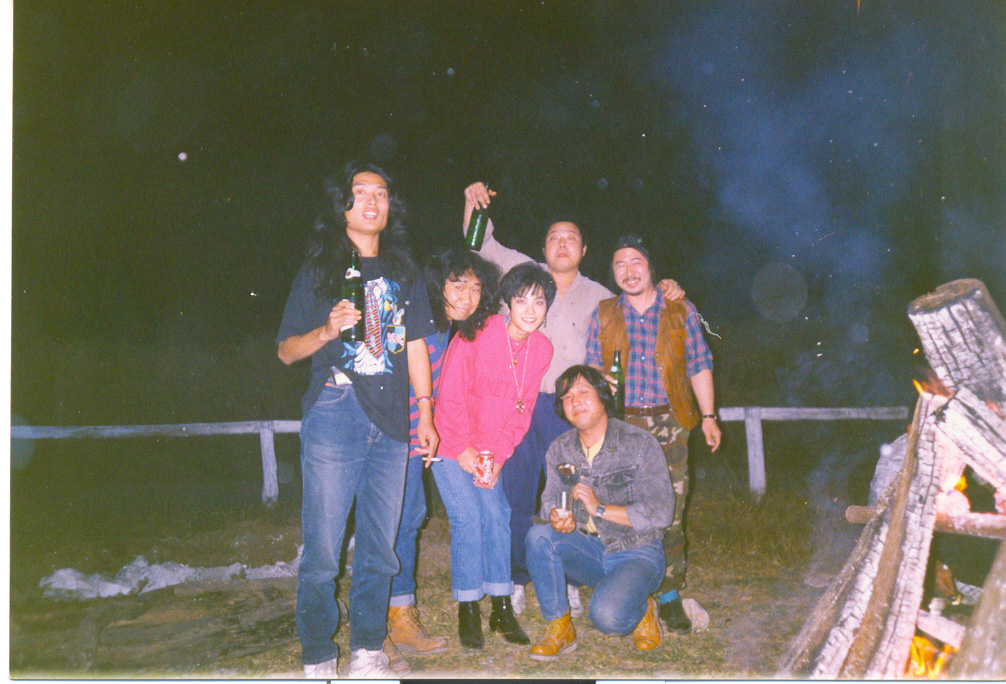
Guo is kneeling in this pic with (from left) Li Tong and Wang Wenjie of Black Panther, Faye Wong, Zang Tianshuo (keyboardist and singer) and bassist Qin Qi.

Black Panther’s big break did not come, like their fellow rockers of the time, at the Modern Music Concert, a two-day six-band concert held in February 1990 at Beijing’s Capital Stadium. Guo’s gear, but not his band, were featured. He took Black Panther and a handful of others to the southern city of Shenzhen, which was celebrating its tenth year as a Special Economic Zone: The former no-man’s-land in the southeastern tip of the country a stone’s throw from Hong Kong, like a select few other SEZ’s, was awarded a license to develop as an experiment.Guo recalled with relish the sight of a planeload of longhairs coming through both Beijing and Shenzhen airports, but the tone changed when recalling the lyrical malfeasance of blues/pop rock band Baby Brother, who mocked the elder leaders in his tune “Cynicism” despite pleas not to play the song. Guo, being personally responsible for anything ‘unhealthy’ that may have gone down, was on the hook, and he almost didn’t make it out of Shenzhen.

Once back in Beijing, Black Panther quickly saw their status grow. A contract with Rock Records, the Taiwanese record label that invested heavily in the Mainland’s rock scene through the nineties, followed, and album sales peaked upon the Mainland release of their debut in 1992.

It was time for a solo concert for Black Panther. Wary of the difficulties of simply booking a concert hall, Guo decided to make the show a not-for-profit event, choosing to donate the proceeds to a senior citizens’ charity. Thus did he receive help from that charity’s most intense supporter, and thus did the Long March, that epic, if possibly exaggerated but seminal 1934-1935 Communist event whereby the Party’s members hiked across the country to escape their enemy and gather the strength that would see them liberate the nation, once again factored into yaogun’s development. First, Cui Jian referenced it in his debut album (Rock and Roll on the New Long March); now, a Long Marcher would join in yaogun’s fight.

Wang Dingguo: Long March survivor, yaogun booster

Wang Dingguo was born in 1913, and by the time she joined up with the Red Army, when they marched through her Sichuanese village in 1933, she’d already unbound her feet and shorn her hair, two things that women tended, at the time, not to do. Wang left the marriage she was forced into at age fifteen and married Xie Juezai, who held high government office from 1949 until his death in 1971. As of the spring of 2011, Wang was one of the very few surviving Long Marchers; in 1993, as Guo prepared for his band’s biggest concert to date, there may have been other Long March survivors, but there were few still up for a fight like Wang Dingguo.

Wang was a major player in the Beijing Senior Citizens’ Committee, comprised of other former officials and dignitaries. Guo Chuanlin pledged to donate RMB30,000 to the charity in exchange for their help getting things set up. Guo seemed to be purposefully vague on the details of how a twenty-four year-old rock band manager becomes inspired to donate the proceeds of a concert to a senior citizens’ hospital, but he had picked his cause and went with it.

Moved by Guo’s idea, Wang Dingguo got involved. Initially, city officials faced with Wang were polite in their fuck-offery, but it quickly became obvious that this was not your average little old lady. When she believed the city government was dragging its heels on concert permits, instead of going home like she’d been told to do, she pledged to set up camp in their offices until permits were issued. “‘These nice young men are trying to do something positive for their elders!'” Guo remembers the old lady chiding. “‘Why is it so difficult?’” It ceased to be difficult, and permits were issued. The cultural bureau was not as easily swayed, unable to abide what they perceived as Guo’s abuse of connections aimed at circumventing their own authority. Eventually, however, the show went on. Despite the overwhelming police presence, Guo recalled, with the aid of over fifteen years of reflection, “It was a pretty successful show.”

Guo Chuanlin is third from the right in this pic of Black Panther and Hong Kong rock band Beyond (photo via yeyeye)

Black Panther grew more successful over the course of the nineties, and continues to perform twenty-plus years later. The band name is known far and wide, while Guo Chuanlin, who, today, produces large-scale festivals and events, remains their best-kept secret.


“Don’t Break My Heart” remains Black Panther’s biggest hits


Foreign Devils: Over a half-million of them

As a former foreign resident of the Middle Kingdom, it was both shocking and unsurprising to hear the number 594,000 bandied about, in this post on the China Beat (yes, that is the site you know from its posting of an excerpt-plus from Red Rock as well as a range of great and insightful readings on China), about how many non-Chinese, in 2010, called China home.

The number is both higher than I thought and lower than it ought to be, and the article points out several reasons this is so. The visa situation for many non-Chinese residents, which is perhaps best explained by evoking the colour grey, means that many foreigners are not exactly counted in official stats. Compounding that situation are the periods of regulatory, erm, adjustments that tend to follow periods of Special Events — say, the Olympic or World Expo periods. But on the other hand, anyone that’s lived in China for an extended period of time knows that foreigners can’t truly live under the radar.

Alas. There are foreigners, a whole bunch of them. And, to turn things, as we often do, back to Red Rock: The Long, Strange March of Chinese Rock & Roll, as long as there have been foreigners, they have used their devilsh ways to spread gospels of many kind, rock and roll being only one of many recent such gospels. There have been many unsung heroes, bringing their collections to the hungry ears of local audiences and several important figures who brought not just the sounds, but the actual artists into the country desperate to experience for themselves the music. And, of course, there have been players.

And so, a brief look, at some of the laowai (“lao [rhymes with ‘how’] why“, literally, ‘old outside’) inside yaogun:

If Cui Jian is yaogun’s Adam, Eddie Luc
Lalasoa Randriamampionina isn’t Eve, and he’s probably not the snake, but he’s definitely one of the other residents of the Garden. Since the earliest days and right through to today — unlike any other musician — Eddie has been alongside Cui, making him the most famous foreigner in yaogun, and one of the most famous foreigners in China. He also played for legendary blues crew Rhythm Dogs as well as the amazing Nogabe, in addition to early band Ado (which became Cui’s band from early one).


One of the first alt bands to come out of Beijing was Xue Wei, a band about which little is known, other than they had a big fan in Cui Jian who told a reporter that he wished they’d play more. Scotsman Colin Chinnery, maven in the contemporary Chinese art scene as both artist and curator, led the band (and is pictured at right). Check out their tune, “Trivial” (微不足道), streaming here.


Thin Man has established itself even into the mainstream, but in the band’s earliest incarnations, Chandler Klose played an essential role; he and still-frontman Dai Qin formed the band, and it was Klose that brought Dai, who had only just discovered the Beatles (and was playing in one of the early-nineties party scene’s favourite bands, which became known as the Mongolian Beatles) under the spell of the alternative music only recently dominating the American rock scene. Klose also played alongside Zang Tianshuo (soon to become a pop star) in the band 1989, but left it for Thin Man. Here, the band’s contribution to 1994’s Original Chinese Rock compilation, “Passed this Place”

P.K. 14 remains atop the yaogun heap, even nearly 15 years after their formation. Soon after Yang Haisong and his now-wife Sun Xia moved the band to Beijing to break into the then-nascent but bubling scene, he met Swede Jonathan Leijonhuvfud, who had brought punk bands on tour through the mainland from his base in Hong Kong. Like Yang, Leijonhuvfud discovered that Beijing was where it was at, and moved there in 1999, joining the band soon thereafter.


Leijonhuvfud also makes an appearance in the short-lived Cocktail 78, which united he and future FM3 co-founder and Buddha Machine co-creator Christiaan Virant with two members of Brain Failure, Xiao Rong and David O’Dell (author of the recent memoir Inseperable, about the punk scene in Beijing) and Jerry Chan, who recently posted a link to not just video of the group performing (sans Chan) at the Great Wall, but also a sample of a track the band recorded in-studio in 2000

Beginning in the early aughts, bands with members from outside of China were less rare: There were more spaces to rehearse and perform and there were exponentially more of us. And we got around. Which doesn’t mean that your humble narrators two most recent bands are unworthy of mention here…

Black Cat Bone, still going despite my departure (as well they should be), formed in 2005ish, is a blooze band of the party-with-us variety.

Finally, RandomK(e), a dark space-post-indie rock band formed in 2005 and disbanded in 2010 with, alas, my departure.