Model ‘Gunner: Guo Chuanlin

The pages of Red Rock, the book chronicling Chinese rock and roll’s path, were limited; the stories of the characters introduced therein were very much unlimited. Guo Chuanlin is one of the book’s characters that deserves more attention.

Guo Chuanlin looks nothing like he ought to. Or maybe he just doesn’t look like I wanted him to. He struck me as middle-management, the kind of dime-a-dozen guy that carries a man-purse made of some synthetic leather-ish material and barks demands at waitresses from across the room in a drunken slur.

Regardless of one’s feelings about the cheese-laden hair-rock band that Guo brought into the limelight, Black Panther is certainly an important band in the yaogun context, and its rise to fame, like Guo’s own career, is a study in the roller-coaster-ride of yaogun, and of the music’s – and its practioners’ – potential to confound expectations. It just takes a while to see it.

Sometime around 1980 Guo bought the first electric guitar in Beijing – for a then-ridiculous RMB80 (about US$12 today, or half of a government workers’ monthly salary then). He is credited as one of the founders of Black Panther, but his role was not, from almost the get-go, onstage. He’d been inspired by reading a magazine article (like so many kids before and since) about an American manager (like just about no kids ever) that had taken a band (which band, Guo can’t recall) from the depths of unknowndom to the heights of superstardom. So he gave up the guitar for, well, whatever one takes up to become a manager. Which is, one must recall, shocking in the context of his world, where there was hardly a space for performers, let alone for anything resembling an industry. But Guo proved that an industry, or at least, rock workers, were necessary.

Guo Chuanlin was unabashed in his retelling of how the vision for Black Panther was culled from equal parts Bon Jovi and Wham!. Even though I knew that Wham!’s gig was a big deal for a lot of people, it really hit home when Guo spoke of Black Panther’s founding (as did the irony: Wham! wanted nothing to do with China; their legacy was huge nonetheless). His vision for the band also included success on a level then known only in foreign magazine articles; the guys in Black Panther thought he was crazy with his visions of rock stardom, and told him it was impossible.

Guo soldiered on. When Guo and his crew were filmed in a rockers-in-the-capital story on Beijing TV, thanks to a buddy that worked for the news, they caught the eye of a potential sugar daddy so eager to help the kids on the news that he sought them out and offered up top-of-the-line gear. Meanwhile, Guo had found a sympathetic middle school principal who offered up rehearsal space in his school, and a music shop owner to lend them temporary gear. The sugar daddy, meanwhile, withheld the promised gear, believing he’d been sold a bill of goods: This wasn’t the song-and-dance troupe he’d thought he’d been investing in.


The type of troupe the sugar daddy likely had in mind

He told Guo that if he didn’t find himself a guarantor, they’d never get the gear. Thus did Guo make the biggest mistake and greatest move in a career of thin lines therebetween: With a persistence and sense of mission of the sort only possible in the young and insane, he walked into a company office based on what he’d seen on a sign. “The word ‘times’ in your company name,” he told the manager he demanded to see, “that, to me, represents modernity.” And the ultimate in modernity was the thing he was offering: A rock and roll band. Which took some explaining. “But this type of thing doesn’t exist,” Guo was told in response to his description of the rock band concept – one begins to see how the sugar daddy felt mislead. Guo convinced the manager that not only did it exist, but that he could get involved. Guo got his guarantor, and the band got its gear.
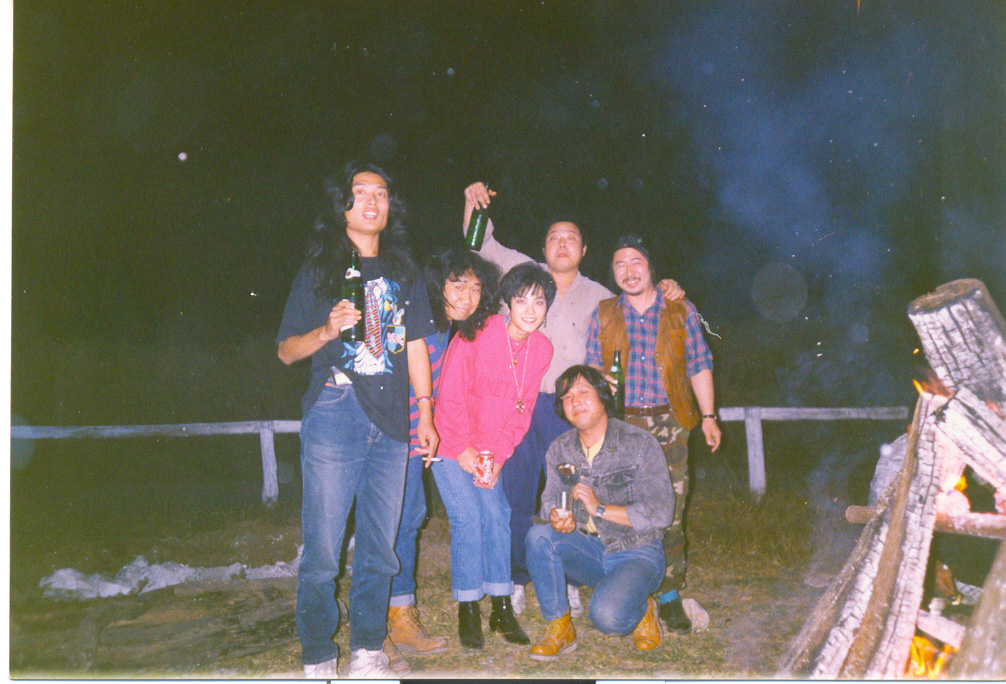
Guo is kneeling in this pic with (from left) Li Tong and Wang Wenjie of Black Panther, Faye Wong, Zang Tianshuo (keyboardist and singer) and bassist Qin Qi.

Black Panther’s big break did not come, like their fellow rockers of the time, at the Modern Music Concert, a two-day six-band concert held in February 1990 at Beijing’s Capital Stadium. Guo’s gear, but not his band, were featured. He took Black Panther and a handful of others to the southern city of Shenzhen, which was celebrating its tenth year as a Special Economic Zone: The former no-man’s-land in the southeastern tip of the country a stone’s throw from Hong Kong, like a select few other SEZ’s, was awarded a license to develop as an experiment.Guo recalled with relish the sight of a planeload of longhairs coming through both Beijing and Shenzhen airports, but the tone changed when recalling the lyrical malfeasance of blues/pop rock band Baby Brother, who mocked the elder leaders in his tune “Cynicism” despite pleas not to play the song. Guo, being personally responsible for anything ‘unhealthy’ that may have gone down, was on the hook, and he almost didn’t make it out of Shenzhen.

Once back in Beijing, Black Panther quickly saw their status grow. A contract with Rock Records, the Taiwanese record label that invested heavily in the Mainland’s rock scene through the nineties, followed, and album sales peaked upon the Mainland release of their debut in 1992.

It was time for a solo concert for Black Panther. Wary of the difficulties of simply booking a concert hall, Guo decided to make the show a not-for-profit event, choosing to donate the proceeds to a senior citizens’ charity. Thus did he receive help from that charity’s most intense supporter, and thus did the Long March, that epic, if possibly exaggerated but seminal 1934-1935 Communist event whereby the Party’s members hiked across the country to escape their enemy and gather the strength that would see them liberate the nation, once again factored into yaogun’s development. First, Cui Jian referenced it in his debut album (Rock and Roll on the New Long March); now, a Long Marcher would join in yaogun’s fight.

Wang Dingguo: Long March survivor, yaogun booster

Wang Dingguo was born in 1913, and by the time she joined up with the Red Army, when they marched through her Sichuanese village in 1933, she’d already unbound her feet and shorn her hair, two things that women tended, at the time, not to do. Wang left the marriage she was forced into at age fifteen and married Xie Juezai, who held high government office from 1949 until his death in 1971. As of the spring of 2011, Wang was one of the very few surviving Long Marchers; in 1993, as Guo prepared for his band’s biggest concert to date, there may have been other Long March survivors, but there were few still up for a fight like Wang Dingguo.

Wang was a major player in the Beijing Senior Citizens’ Committee, comprised of other former officials and dignitaries. Guo Chuanlin pledged to donate RMB30,000 to the charity in exchange for their help getting things set up. Guo seemed to be purposefully vague on the details of how a twenty-four year-old rock band manager becomes inspired to donate the proceeds of a concert to a senior citizens’ hospital, but he had picked his cause and went with it.

Moved by Guo’s idea, Wang Dingguo got involved. Initially, city officials faced with Wang were polite in their fuck-offery, but it quickly became obvious that this was not your average little old lady. When she believed the city government was dragging its heels on concert permits, instead of going home like she’d been told to do, she pledged to set up camp in their offices until permits were issued. “‘These nice young men are trying to do something positive for their elders!'” Guo remembers the old lady chiding. “‘Why is it so difficult?’” It ceased to be difficult, and permits were issued. The cultural bureau was not as easily swayed, unable to abide what they perceived as Guo’s abuse of connections aimed at circumventing their own authority. Eventually, however, the show went on. Despite the overwhelming police presence, Guo recalled, with the aid of over fifteen years of reflection, “It was a pretty successful show.”

Guo Chuanlin is third from the right in this pic of Black Panther and Hong Kong rock band Beyond (photo via yeyeye)

Black Panther grew more successful over the course of the nineties, and continues to perform twenty-plus years later. The band name is known far and wide, while Guo Chuanlin, who, today, produces large-scale festivals and events, remains their best-kept secret.


“Don’t Break My Heart” remains Black Panther’s biggest hits


Foreign Devils: Over a half-million of them

As a former foreign resident of the Middle Kingdom, it was both shocking and unsurprising to hear the number 594,000 bandied about, in this post on the China Beat (yes, that is the site you know from its posting of an excerpt-plus from Red Rock as well as a range of great and insightful readings on China), about how many non-Chinese, in 2010, called China home.

The number is both higher than I thought and lower than it ought to be, and the article points out several reasons this is so. The visa situation for many non-Chinese residents, which is perhaps best explained by evoking the colour grey, means that many foreigners are not exactly counted in official stats. Compounding that situation are the periods of regulatory, erm, adjustments that tend to follow periods of Special Events — say, the Olympic or World Expo periods. But on the other hand, anyone that’s lived in China for an extended period of time knows that foreigners can’t truly live under the radar.

Alas. There are foreigners, a whole bunch of them. And, to turn things, as we often do, back to Red Rock: The Long, Strange March of Chinese Rock & Roll, as long as there have been foreigners, they have used their devilsh ways to spread gospels of many kind, rock and roll being only one of many recent such gospels. There have been many unsung heroes, bringing their collections to the hungry ears of local audiences and several important figures who brought not just the sounds, but the actual artists into the country desperate to experience for themselves the music. And, of course, there have been players.

And so, a brief look, at some of the laowai (“lao [rhymes with ‘how’] why“, literally, ‘old outside’) inside yaogun:

If Cui Jian is yaogun’s Adam, Eddie Luc
Lalasoa Randriamampionina isn’t Eve, and he’s probably not the snake, but he’s definitely one of the other residents of the Garden. Since the earliest days and right through to today — unlike any other musician — Eddie has been alongside Cui, making him the most famous foreigner in yaogun, and one of the most famous foreigners in China. He also played for legendary blues crew Rhythm Dogs as well as the amazing Nogabe, in addition to early band Ado (which became Cui’s band from early one).


One of the first alt bands to come out of Beijing was Xue Wei, a band about which little is known, other than they had a big fan in Cui Jian who told a reporter that he wished they’d play more. Scotsman Colin Chinnery, maven in the contemporary Chinese art scene as both artist and curator, led the band (and is pictured at right). Check out their tune, “Trivial” (微不足道), streaming here.


Thin Man has established itself even into the mainstream, but in the band’s earliest incarnations, Chandler Klose played an essential role; he and still-frontman Dai Qin formed the band, and it was Klose that brought Dai, who had only just discovered the Beatles (and was playing in one of the early-nineties party scene’s favourite bands, which became known as the Mongolian Beatles) under the spell of the alternative music only recently dominating the American rock scene. Klose also played alongside Zang Tianshuo (soon to become a pop star) in the band 1989, but left it for Thin Man. Here, the band’s contribution to 1994’s Original Chinese Rock compilation, “Passed this Place”

P.K. 14 remains atop the yaogun heap, even nearly 15 years after their formation. Soon after Yang Haisong and his now-wife Sun Xia moved the band to Beijing to break into the then-nascent but bubling scene, he met Swede Jonathan Leijonhuvfud, who had brought punk bands on tour through the mainland from his base in Hong Kong. Like Yang, Leijonhuvfud discovered that Beijing was where it was at, and moved there in 1999, joining the band soon thereafter.


Leijonhuvfud also makes an appearance in the short-lived Cocktail 78, which united he and future FM3 co-founder and Buddha Machine co-creator Christiaan Virant with two members of Brain Failure, Xiao Rong and David O’Dell (author of the recent memoir Inseperable, about the punk scene in Beijing) and Jerry Chan, who recently posted a link to not just video of the group performing (sans Chan) at the Great Wall, but also a sample of a track the band recorded in-studio in 2000

Beginning in the early aughts, bands with members from outside of China were less rare: There were more spaces to rehearse and perform and there were exponentially more of us. And we got around. Which doesn’t mean that your humble narrators two most recent bands are unworthy of mention here…

Black Cat Bone, still going despite my departure (as well they should be), formed in 2005ish, is a blooze band of the party-with-us variety.

Finally, RandomK(e), a dark space-post-indie rock band formed in 2005 and disbanded in 2010 with, alas, my departure.

Touring in China: Crazy!

We've come a long way from Cui Jian's map, 1992, of cities to be liberated on his Long March of Rock and Roll (via Jeroen de Kloet)

Sometimes, you forget that the touring situation for bands coming into China is actually quite normalized. There are clubs, presenters of some form, festivals and audiences awaiting in major cities across the length and breadth of the map. Rock, jazz, folk, metal, blues and other bands have been on what could be diplomatically referred to as trouble-free tours — speed bumps exist and appear on the proverbial road with a predictable regularity (though the size, shape and form of the bumps are never predictable), but a system, of sorts, is in place and has been, for a few years now. Just because it doesn’t look like touring the States doesn’t mean it’s not a system.

But, like I said, sometimes you forget. Because sometimes, you come across word of the recent experiences of a family band in China. And then you remember that there are crazies operating just outside the ‘system’ to which I referred, close enough to give the impression to bands of the rock ilk (those that play clubs, tour and sell CDs) that they are yet another presenter of gigs in the general rock and roll understanding of the term, but far enough from it that anyone who’s even had a glance at the touring road of the Middle Kingdom can smell an intruder from a mile off.

The trials of Joei and the Fulcos — and, I must add, these are not trials that seem to have upset the group/family much; they had their rose-coloured glasses on for their entire China visit, and it’s a good thing — are one reminder of the Other Side. The Fulco family, who describe themselves as the Partridge Family with attitude (and who were featured on ABC TV’s The Wife Swap), was drafted to perform at the Zhangjiajie International Country Music Festival. It’s a festival that has a pretty wide-ranging definition of country music, as evidenced by the festival website’s rundown of performers, such as the Wangqing dance troupe, at left, from northeastern China.

The Fulcos’ bio does not seem to appear on the festival site, but their bio wouldn’t seem to belong among the dance troupes and large numbers of nothing-to-do-with-country-music acts gathered under Zhangjiajie’s banner (see, also, this article for a look at who was on the bill). The China Daily emphasized the tourist-related benefits of such a festival — alarm bells to the ears of those familiar with China’s frenetic festival scene, where local government departments with visions of endless tourist revenues are eager to jump into the festival-production fray — and concluded with talk of the mayor cartoonified, strumming a guitar to “Country Roads” (pictured above; the video is here).

While one doesn’t want to take away from the Fulco family experience, one does want to emphasize the variety-show nature of the type of tour on which the band was put. The best thing that can happen with these wacko tours is that they create good fodder for writing and for stories told around the proverbial campfire. The worse thing that can happen, though, is that bands with genuine hopes fanned by excited and excitable presenters will wind up upset at the prospect of being little more than performing monkeys helping to sell condos in some far-flung minor city, or in front of an  audience super-psyched to get photos and autographs but one that doesn’t, on the large scale, tend to be too picky. Or, remember your name beyond “band from USA”.

Is there a chance that the Fulcos, and others before and after, can win hearts and minds over to the rock and roll (or country, or anything genuine, authentic or remotely original)? Absolutely. Is that part of the draw of touring China? Certainly. Having been on stages large and small in front of just those kinds of audiences, I’ve been both excited and depressed by the prospects, experience and aftermath. And the Fulcos’ experiences underline a big reason for touring in the first place: It’s news-worthy, a peg upon which a band, even in 2011, can hang some nice press coverage back home.

But for a band making a cross-continental trip, the key is to know what one is getting into. So Future Fulcos and assorted others: The Chinese music industry is in its infancy. Don’t be afraid, but do be aware.

New Jersey Rocks

Armpit jokes may abound, but there’s a reason the land whose fertile ground birthed not only The Boss and Bon Jovi rocks even harder these days:

Mi Jiayan’s seminar on Rock ‘n’ Roll in Post-Mao China. I was told that they’ve just finished the Cui Jian unit, and are on to Tang Dynasty.

I mean, Denmark gives a valiant effort with the Danish Rock Council, the government agency devoted to educating the world in the ways of Danish rock. The mere existence of that agency impressed me (and, subsequently, flattered me, when, first, they spent money on sending me to Denmark, and then, on sending Danish rock bands to me, in China like, for example, these ones).

But Joizy takes it up a notch with the yaogun seminar. Get thee to The College of New Jersey!


Same Story, New Locale UPDATED

Ok, not exactly the same, but close.

Afghanistan had their first rock festival in “more than thirty yearsover the weekend. One observant in the ways of rock in China, while impressed and excited about the idea and execution of the event, can’t help feeling a twinge of recognition, and disappointment, in the way the event was portrayed. As a result of the allure of rock music outside the West, there’s a nearly-by-the-numbers form that stories like this take.

To wit:

The story is not filed under ‘music’, but rather, under general news, and there’s a suspicious lack of coverage or sampling of the actual music being performed that could, were one a pessimist, be taken for a judgement about the quality thereof (unless it’s a sign that the reporter is not one schooled in or comfortable talking about music). When music journalists are sent to cover the story, we can figure that the interest is less than passing.

There is, always, the “weird” local twist: China has censored lyrics and a tea-sipping Party presence, while in Kabul we have pauses in the action for neighbourhood prayers, no booze and kebabs-only snacking.

There is the requisite reference to the disapproving eyes of onlooking elders: Dressed, in China, in Mao suits and hats; in Kabul, “turbans and long beards” (who were, one must grant, quoth Reuters, “not entirely disapproving”).

There is, too, an element of danger hanging not far into the background of the story, and it is more than any parental disapproval. This sets up the rock-as-freedom paradigm, which tends to (not always incorrectly) colour discussions of rock in these frontier territories. In China, there is certainly an Official disdain of expression a-la rock and roll and political consequences of being on the bad side of it, though these days, when every podunk city of ten million has their own rock festival, it is less severe than in the past, despite what some reports might imply. In Afghanistan, though, the threat is much more imminent: With the Taliban roaming, there is genuine danger in the idea of a gathering for rock fans in Afghanistan’s capital. At least, that’s how one would figure based on the news reports one hears about the country; it’s a reasonable assumption to figure that, like in the case of China, there are massive misconceptions about the country based on the news.  But we can surely trust that in Kabul, there is genuine danger in gathering to worship on the altar of rock and roll.

So, in rock and roll terms, is Afghanistan the next China? And: Will it bode good or evil for the nation’s scene? There’s still a mixed legacy of international coverage on China’s journey, a legacy that, one hopes, one’s book-length examination (ok: just plain Book) of China’s rock and roll development will help to improve. Afghanistan certainly has a China-sized obstacle to overcome before news of a cultural sort can be processed by outsiders without being overcome by headlines involving chaos, war and more.

Meantime, check out the organization behind the festival. (One could point out how the international nature of the org adds to the deja vu, what with China’s rock and roll history being peppered with folks from outside the Middle Kingdom and all. If one were looking to name names, one might bring up the French restaurant Maximes, which was the earliest regular host of rock shows in Beijing, or the German Udo Hoffmann, who was instrumental in the early-nineties party and proto-festival scene).

And also, while you’re at it, check out the travels and tales of the festival’s head.

Most importantly, though, be sure to listen to the artists that participated in the festival. And let’s hope there’s more to come.


The Update:

I was remiss for not mentioning the efforts of Luk Haas, who has been collecting and releasing music from hitherthen-uncharted rock/punk/etc territory (including, one is quick to add, China!) at Tian An Men 89 Record for years now. Here’s a guy that skips the ‘this is news’ step and goes right for the music, and there are many others like him, like Jason Flower, who wrote a history of Victoria’s underground scene but also got further afield for tracking down Mongolian fuzz-rock and Inuit metal.

Also, WNYC’s Soundcheck interviewed one of the organizers of Kabul’s festival: Sound Central: The Central Asian Modern Music Festival, as well as talked about rap’s role in the Arab Spring.