UPDATE: The China Beat has a good breakdown of train-crash talk and points to this article on China Geeks with the translated lyrics (though a correction should be noted: Cui did not sing the song to the Tiananmen protesters, at least not according to the recording of the four-song set put up online a couple years back).
Lots of talk, lately, about the high-speed train collision on July 23 near the eastern Chinese city of Wenzhou, particularly about the general anger over the Official response. A report on Public Radio International’s The World relates this to yaogun: The song that was the first expression of China’s own homegrown rock and roll, Cui Jian’s “Nothing to My Name”, has been used to express that anger.
Cui’s song (lyrics here), first performed in 1986 and spread quickly and widely thereafter, expressed the feelings that his fellow citizens either didn’t realize they had or couldn’t figure out how to make known. Its power was in its subtelty; Cui was expending a huge effort with his moans, yes, but he wasn’t screaming, because he, and his generation, weren’t exactly angry – not yet, anyway. The song, and the way people took to it, was a product of the era’s angst and confusion: Unlike the pop music of the day, Cui Jian sang about the sudden confrontation with a new world, both inside and outside of China, and with the possibility that their own world as they knew it was coming to an end.
The “Nothing to My Name” that has emerged the wake of the train crash is a very different beast, as is the generation that produced it. This version, particularly with the accompanying video footage, isn’t just angry, it’s a call to arms. Many have pointed to the song’s role in the events of 1989, but Cui has never been the type to demand people to rise up – not directly, since the immediate reaction doesn’t take the long view. It was a revolutionary tune, to be sure, but it was not incendiary in the way that the tweaked version now making the rounds is.
“Oh… You seem to be making a show” struck me in particular. The idea that much of the news coverage in the Middle Kingdom was less than actual news is not new: It’s been a long time since intelligent people believe they’re getting the full story on just about anything from the newspapers and newscasts of the Official Media (an argument which can be made of many nations, one is quick to add, though it’s not always easy to spot the “official” outside of China). What’s new is the eagerness to call it when it’s seen, not to mention the media’s own desire to editorialize on the issue – there’s the rage of the anchor at the top of the video, and the CCTV anchor mentioned in the PRI report who implored the nation to slow down, lest it leave behind the souls of its citizens. This type of expression, at least among the general populace, also happened in the wake of the Sichuan earthquake of May, 2008 (and the image of the candle-lit “7.23” in the video is the link to that episode) and it’s happening moreso now, inasmuch as its being allowed by Officialdom.
Alas. Back to Cui Jian.
I’d always been dismissive of Cui Jian’s own campaign, in the first years of the aughts, againstlip-synching (which, recall, led to actual legislation banning the practice without telling people you were doing it), but in revisiting that campaign, particularly in light of a situation such as the one around the train crash, one understands what he might’ve been trying to do – and it’s been something he’s obviously been trying to do through his music, and general example. To get people to think. If people are telling you they’re singing and they’re not, what else out there is fake?
Whether this new “Nothing” merely riles folks up in the short term or leads them to reflect on the long is the difference between yaogun’s ability to shock and its ability to awe; its power and its potential.
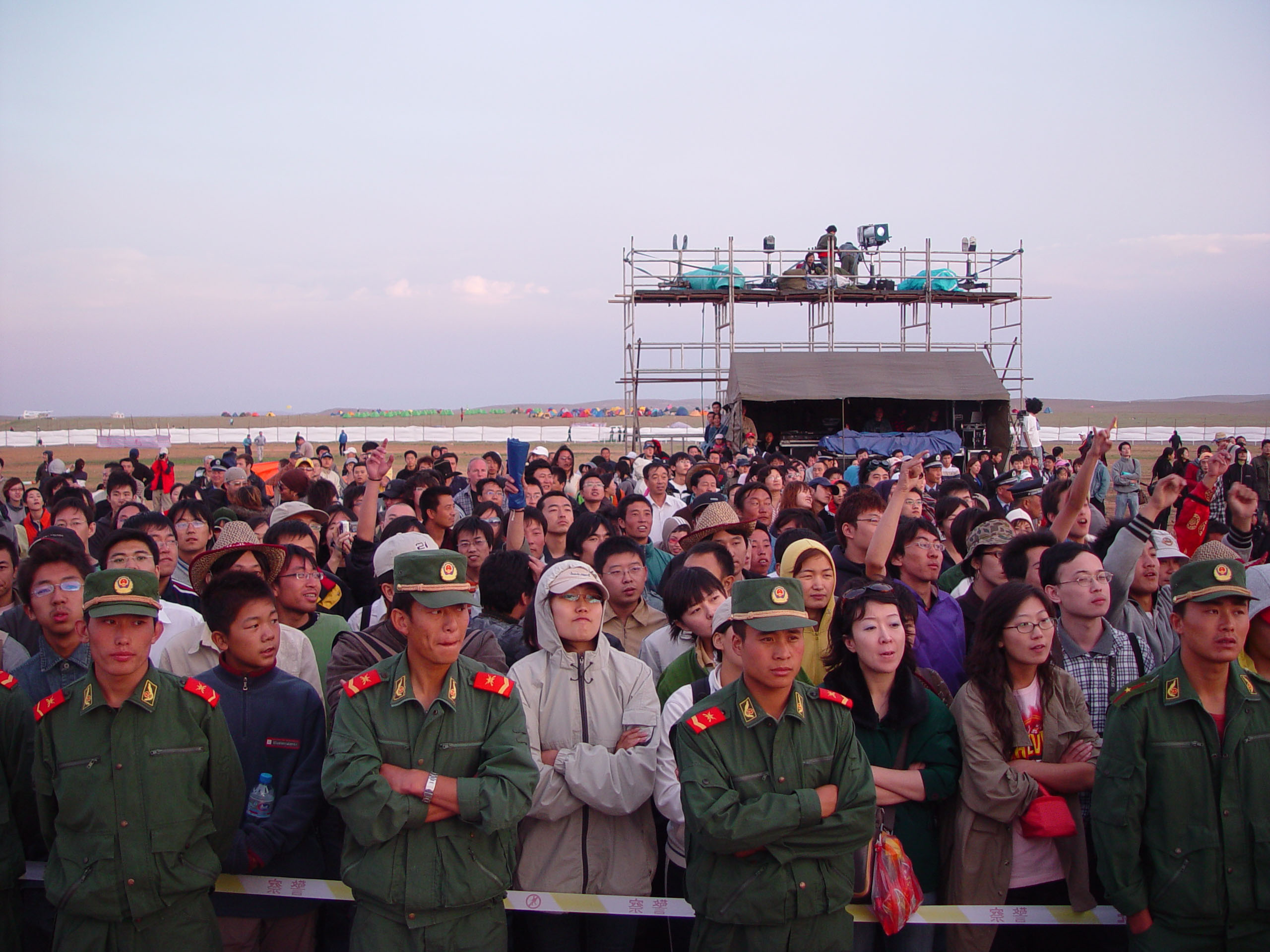
It’s festival season throughout much of North America and Europe, and I was going to say it’s festival season across China as well, but that would only be part of the story: Festival season, lately, has been happening multiple times each year. In recent years, with “explosion” being a massive understatement, it’s hard to know when the season ends (festivals used to be limited to the holiday weekends of Oct 1 and May 1). Between late July and early August I know of the following festivals: 2011 Ocean Midi Music Festival, Ark Beach Music Festival, the InMusic Festival, Zebra Beach Music Festival, Rock Aid and the Da Ming Palace International Music Festival. There are others, but it’s nearly impossible to keep track.
Midi Festival, Beijing, 2010
Many point to the proliferation of music festivals across the country as a sign that things are looking good for yaogun. An important half truth at the very least: Music festivals – or, more accurately, events with the word ‘festival’ in their name – are, indeed, an increasing occurrence around the country, especially as local governments have come to see value in backing such events.
Festivals make both a good and bad model upon which to base a judgement on the rock scene, because, like the scene itself, looks are deceiving. Just as it takes more than a proliferation of bands to make a vibrant and internationally-ready rock scene, there’s more to a Festival Scene than an increasing number of stages under the banner of ‘festival’. And an increasing number there certainly is: Check here, at the encyclopaedic Rock In China, for a list of many recent festivals.
Some recent highlights include: The short-lived Beijing Pop Festival, which brought an increasingly significant lineup of international acts, culminating with Public Enemy, Nine Inch Nails and others in its final, 2007, event. Record label – and, many would add, PR agency – Modern Sky has an eponymous festival as well as the Strawberry Festival and a folk festival in various locations across the country. The Zebra Festival emerged in 2009 in Chengdu and has plans for expansion (in 2010, the fest went to Hangzhou; 2011 saw a Shanghai version). The Midi Music Festival, most often referred to as the leading festival light of the country, has long outgrown the campus of the eponymous music school where it began in 2000, with events outside of Beijing beginning in 2009 and expanding rapidly thereafter.
Each festival has had, and continues to have, its own challenges to overcome both from outside – the unpredictability with which the authorities limit the events, for one – and inside – organizational chaos leads to festivalian chaos – though anyone beyond industry insiders would be excused for seeing nothing but good news: The festivals look right and get great coverage in the local and international media. But artists, staff, volunteers and observant attendees (and I have been in all of those categories) run into elementary problems of the type that shouldn’t exist at this level. It’s not that the glass is half-empty, it’s that it’s hard to know what kind of cup we’re talking about, and what kind of liquid (if a liquid at all) is being poured (unless it’s being drained). And the more pouring that gets done, the tougher it is to get the stuff to go into the glass.
“In China, if someone does something successfully, then all of the sudden, there’s a million people doing it,” influential radio DJ Zhang Youdai told me. “It ends up ruining things for everyone. Recent festivals have turned people off.” He said this in 2009, and while things then seemed to be getting out of hand, it was nothing compared to what was to come (one is also quick to add that Youdai himself headed up a festival in 2011, Kama Love, which received goodreviews)
Over the course of the millennium’s first decade, a number of festival attempts were made, to varying degrees of success. There were the non-festivals, like 2003’s First Annual Lattetown Music Festival, named for the condominium complex (one of a million ridiculous real estate development names in the country) in the southern outskirts of Beijing. Metal bands Suffocate and Spring and Autumn joined pop-punks Reflector and grunge guy Xie Tianxiao and others celebrate the condo’s opening. “We’re trying to show that Lattetown is a fashionable and modern place,” said one saleslady charged with handing out pamphlets that day to the mix of rock fans confused over the setting and nouveau riche confused as to why their search for a new house had to be so loud.
Death metal band Suffocate at The First Annual Lattetown Music Festival, 2003 (there was no Second Annual)
There was 2005’s cryptically dubbed “Carnivalesque Party of 1 vs. 120,000”, part of the International Beach Tourism Culture Festival, in the small city of Beihai, in southeastern Guangxi province that combined rock performances with a bikini competition. Soon thereafter was the Gegentala Grasslands Music Festival, which seemed to be a decent enough festival with good potential for a future, but was revealed to be an attempted cash grab by a Sichuanese strawberry magnate. The trip out to the Inner Mongolian grasslands looked like it would be worth the ride until the supposed seven-hour ride became, for many, a twenty-hour nightmare; word was unpaid bills nearly stopped the music on several occasions. Gegentala, Part II was not forthcoming; meanwhile lodging and food prices had been inflated to the point of comedy.
Gegentala Grasslands Music Festival, 2005
What’s interesting about the current situation – in which one estimate claims that 2010 saw as many as one hundred festivals; all indications point to an increase in 2011 – is how suddenly it all seems to have happened. Which isn’t exactly the whole story: The festival era didn’t begin with the Midi Festival, and what’s more, despite appearances, things haven’t come all that far.
In 1990, then-new-Beijing resident Udo Hoffmann put together what he says is the country’s first festival. News of the event got to a city official who said that ‘hell had opened its gates’, so it wasn’t a huge surprise that his Hoffmann’s second attempt – for which, he says, five thousand tickets were sold – was cancelled two days before the event. He learned from those first events, though. In 1993, he started the Beijing Jazz Festival; the event lasted through until 2001. Hoffmann was also behind the Heineken Beat festival, held in Beijing in 1999, 2000 and 2001, it was the first large-scale international festival in the country (the lineups for the Jazz Festivals and Heineken Beat are here).
1990’s 90 Modern Music Festival was a two-day event featuring Tang Dynasty, Ado, The Breathing, 1989, Cobra and Baby Brother (Baobeir Xiongdi) at Beijing’s Capital Gymnasium that was said to have drawn eighteen thousand spectators. In a similar vein was the New Music China Xinxiang Concert, for which Huang Liaoyuan brought nine bands – via a “rock and roll train” full of musicians and fans – to a stadium in the small city in 1998. Six years later, he put together the Helanshan Music Festival alongside a motorcycle festival in the desert of western Ningxia. Other than the hard-to-reach venue, the reviews were positive.
2002’s Snow Mountain Music Festival, held in the southwestern corner of the country, nearby the once-mythical and recently-official Shangri-La, was supposed to be the Chinese Woodstock that everyone had been waiting for. With Cui Jian as the festival’s artistic director, the international media certainly played it that way, but the rainy season and the far-flung locale kept the audience numbers low. Episode two wasn’t until five years later; subsequent installments went further away from rock.
In the first years of the nineties, filmmaker Sheng Zhimin (whose 2009 Night of an Era [再 见乌托邦] is a fantastic look at the nineties’ rock scene), like many current festival organisers, was approached by a local government official who was told that adding a rock component to an otherwise unsuitable-for-rock event would be great for local business. His ‘festival’, which took place inside a (working) roller coaster in a Beijing suburban celebration of Chinese New Year, was put together with not much more than his personal connections to local bands and the dreams that he and his crew had from watching Woodstock videos. The situation would be laughable if one didn’t appreciate Sheng’s deep sense of mission. What is laughable, though, is when one is confronted with the possibility that not much since has been learned.
The governmental support that abounds these days – it is a shocking thing to behold – is one of the reasons that it’s easier for festivals to flourish. “As long as the musicians are healthy and not opposed to the Communist Party, why not let everyone enjoy the rock and roll?” Li Xuerong, secretary the local Communist Party Committee for Zhangbei, the site of the InMusic Festival, told the Global Times. Li’s comments represent the feelings of many a local government official eager to put their own towns on the map, and, for now, are convinced that music festivals help them do that. Multiple-year deals between local governments and festival organisers have been signed, a trend that looks to continue as long as it appears that the festivals are adding to the image of the locales in which they are held.
On the other hand, festivals are still battling the cultural obstacles of a nation new to the idea of massive outdoor events. “People go to restaurants – they don’t even really go to bars,” Liu Chang, a Midi School graduate who has worked on the Midi Festival since 2007, says. “Most people who go to the festivals probably have no knowledge of the music or any band. To them it’s a simple gathering.” Liu Chang’s boss, Zhang Fan, knows this to be true: “Fifty percent of (the audience) aren’t necessarily coming for the music,” he was quoted, in 2006, as saying. “They’re just coming to have fun.” While there are certainly a few fan favourites, the overall idea was that you could go to the park, hang out, and maybe possibly see some music you’d like. “For the festival-goers, half of the time is spent wandering around,” he told a China Daily reporter in 2007. “The festival is not only performances but rather, a relaxed lifestyle.” Add to that the far-flung locales festival organisers are now exporting to, and you have an audience comprised of a large number of locals just trying to figure out what the heck is going on in their hometown. If people are attracted to a music festival for any reason other than music, we are not talking about an event that gets filed in the same category as Boneroo, no matter how many people are in attendance – and that number is impressive – or how many stages may dot the grass fields of any given park in the Kingdom.
And one ought to look critically at who is standing upon these stages. I knew I’d been seeing the same names year after year, but it came home after a quick survey of Midi Festival lineups from the past dozen years. Miserable Faith and Yaksa have appeared at twelve Midi Festivals; AK47 and Brain Failure at eleven; Twisted Machine and Sand, ten; Subs seven; Ruins and the Verse (six). Here is not the venue for debating these bands’ worthiness for the stage. But it is the venue for questioning the variety in the lineups of the country’s leading festival – and, by association, the country’s other festivals, who are all picking from the same limited pool. When festivals go looking for the local Big Guns, they don’t stray far from that list. There is Cui Jian, the biggest star in the country; Xie Tianxiao, who is being tagged as Cui’s successor. There are a few others, who straddle that line betwixt yaogun and pop: Wang Feng, He Yong, Zhang Chu, Xu Wei, Tang Dynasty, Zero Point, Heaven.
What one hopes is that festivals live up to their potential, and bring yaogun with them. What one fears is the triumph of the status quo: The same bands headlining the same events plagued with the same problems.
The July issue of monthly Beijing English-language magazine the Beijinger featured a cover feature on yaogun, or, more specifically, the talking thereof (the article is downloadable here).
Under the banner of “The Great Music Debate”, the magazine gathered a dozen and a half members of the music community in a room, threw out some questions and took notes. There were folks from all corners in on the talk: Reps from record labels, festivals and venues; promoters, performers, observers and writers.
One thing in particular that struck me (other than a nice mention of yours truly) was the couple of occasions on which the general lack of recognition for that which came before was raised. It’s is something that I’ve fought hard to counter in recent years; it was, truth be told, in direct response to the realization that I hadn’t been giving the early years and those rocking therein the respect they deserve.
That recognition isn’t just a major theme running through Red Rock – my aim was to focus on the journey and the people that had paved the way – but it was the inspiration for it. It didn’t start out that way, but digging into yaogun’s history showed me the importance of the contributions of the early ‘gunners. (Which is not to say that Red Rock is only about the past; it is about, inasmuch is possible for any book, the current state of affairs in the context of how it came to be. Context, turns out, is everything).
So, with my ‘history is everywhere’ goggles on, when I saw the rock-talking panel in July’s Beijinger, I couldn’t help but think back to 2005, when, along with several members of the staff of the magazine then called that’s Beijing (now called the Beijinger), we gathered seven rock-scenesters to sit down over beers and talk rock.
In 2005, times seemed simpler. It felt like yaogun was still finding its footing; its glory days were far enough behind it that they seemed ancient history, and it wasn’t clear how it might regain any semblance of that time. The conversation had an overall pessimistic tone; there was a lot of talk about the obstacles up in yaogun’s way. It was a time, as Lv Zhiqiang (also known as Gouzi [‘go-dze‘), or ‘Dog’), put it, of challenges. “I think the music scene is in a bad way because nobody thinks of what’s wrong with it and how to solve the problems.” Lv ran then, and runs now, live venue Yu Gong Yi Shan (which was demolished and relocated to much fancier and larger digs in 2007). “We should figure out what’s wrong, and fix it.”
There was little international interest in yaogun then, in a way that seems inconceivable these days. Though one of the panelists, Leo de Boisgisson (as well as myself, though officially an observer rather than a participant), was in the business of exporting Chinese music along with bringing in international acts, it didn’t seem like yaogun was ready to take on the world just yet, as international touring for local bands was extremely rare (de Boisgisson had taken three amazing acts on a French tour the previous year; I was about to head to Scandinavia with Subs; a literal handful of others had made international trips).
China Music Lab, France, 2004; Subs, Nordic Europe, 2005
Back then, there seemed to be no sign of the internet life as we know it today. Case in point: In 2005, we thought it important that a record store owner was in on the conversation. In 2011, Tian Jianhua, of skate-punk band Reflector, put it best when he said: “Times have changed, brother – nobody listens to CDs anymore.”
Changed, indeed. In 2005, “Stanley” Chen Yi, who was, then, PR Manager at Beijing label Scream Records, could still genuinely describe the kids buying his label’s records as folks that “regard rock music as their spiritual pillar…if they don’t have rock music, they may lose the meaning of life…(Nothing will change) their love of and attitude toward rock. It’s a part of their life.” This is the type of rocker I continually encountered during my yaogun research, and though it sounds pretty cheesy to hear it in this age of gigabytes of music swirling through the air, in one’s headphones on demand, one can’t emphasize enough how deeply these feelings were felt.
But not so much anymore. Tian Jianhua, himself having been deeply affected by rock and roll – and who, in turn, affected deeply through his own music, multitudes – put it succinctly during the 2011 panel: “The younger generation grew up eating McDonald’s. They’ve never had time to think deeply about anything.”
It’s the difference, broadly, between the pre- and post- Eight-Ohs, the general generational divide slapped through China’s young adult population (which, like any generalization, works only to an extent). Those born after 1980 (‘eight oh’) are painted with the broad strokes that describe that “Little Emperor” phenomenon, that unintended consequence of China’s one-child policy. When families of multiple generations share a home in a world defined by that definitely-post-1980 mission to make mounds of money, it’s bound to happen. There’s more money to spend on kids, and a desire on the part of parents and grandparents to overindulge their only progeny. Add to that the technology with which these young’uns are surrounded and from which they seem to draw their very life blood, and what you get is not just a belief that all ought to be available all the time, but that this is how it always was and always will be.
So the idea of rock star has become different. Less something to strive for, or, gasp!, earn, than yet another thing on a list of desires that invariably get gotten for them. Again: these brush strokes are broad, but useful still.
Between 1993 and 1997, Niu Jiawei, who participated in our 2005 rock talk, worked at the Beijing office of Magic Stone Records, the label opened on the mainland by Taiwanese outfit Rock Records to cover yaogun. This was Magic Stone’s – and yaogun’s – heyday, when records sold widely and rock rang out from the stadium stages, radio stations and cassette players of the nation. Magic Stone and a few others created rock stars out of dudes previously slugging it out in the venues of the country’s underground. “It’s a problem if things develop too fast,” Niu said, in 2005, citing the record time in which rock stars were made, and the swiftness with which they were dethroned. “There was a crash. I don’t think rock musicians are suited to live like stars.”
Stars of yore: Black Panther
Which is not what folks seem to be thinking in 2011. This year’s panel wrapped up with talk of the value and usefulness of handing out rock awards. Already, two such events occur: Mao Livehouse, the premier live rock venues of Beijing and Shanghai, has been hosting awards from their earliest (2007) days with a nice mix of folks nominated and awarded. Midi Productions, those behind the Festival of the same name, decided, in 2009, to give out awards as well; reviews of Midi’s Awards have been mixed (I have been on the Midi jury, and am more often than not disappointed with how things turn out; more on that, I’m sure, eventually).
“Awards help to establish standards and attract more attention from the fans,” Liu Huan, deputy general manager of the Midi Festival and Midi Productions told the panel. “We need to make the stars stars.”
That statement is what differentiates the two rock panels: In 2005, we weren’t talking about stars, we were talking about survival. And it’s tough to know where I’d rather be.
Seems that this blog will alternate through time. We started at the beginning; we now continue to the recent present. We will thusly hop around for the foreseeable future.
Radiohead opened an account on the Chinese microblogging site, Weibo.
Maybe.
If it’s actually Radiohead (an enormous “if”), nine days after posting “testing the weibo”, they have 67,500 reasons to post something more. If it’s not Radiohead, which is a distinct possibility (nothing more has been posted as of now, other than just about 4600 comments from fellow weibo-ers), they might want to consider joining the fray.
The Guardian asked what I thought, in this article, which ran on July 6, five days into Reibohead.
If any band can attract a loyal, hip, intelligent and savvy group of netizens to help their cause, I told the paper (the ’cause’ being accruing interest in a China tour, or of record distribution, rather than, say, freeing political prisoners), it’s definitely Radiohead. They could, I continued, employing the kind of subtlety and reasonableness much-needed in our over-hyped world, be kings of the virtual world.
Of course, it’s unclear if they opened the account at all. And if they did, whether it was done with an eye to performing, or just, you know, to “test”.
Their politics are what everyone’s talking about vis. China, which is reasonable, especially if the idea is to post on weibo the kinds of things they’ve been posting in other forums — which they won’t be able to do.
It’ll be a long time before the group gets permission to play in China (and before that, it’s arguable that the country isn’t ready, technically, for what that would entail). Certainly playing for/supporting/encouraging support for, say, an ethno-religious group headed by an elderly monk in a small Indian mountain town isn’t the kind of thing that looks good, in China, on a resume. Forget the permit-issuing authorities; it’s not likely an application would even be submitted (even if presenters could afford the fee or get specs up to snuff). Sinologist Perry Link talks about censorship in China as the “anaconda in the chandelier”: The snake will generally leave you alone, so long as you don’t poke at him. Radiohead, in this scenario, is the big, long stick.
Alas.
Like most bands, whether or not they know, tried or cared, Radiohead does, in fact, have something of a presence in China already, via, first, dakou, or ‘saw-gash’ tapes and CDs:
via http://www.verycd.com/groups/@g2385974/659802.topic
…and later, thanks to file-swapping, p2p-ing, and the fact that in the post-OK Computer world few rockers or fans would not be aware of or attentive to Radiohead, whether in Beijing or Brighton. And, of course, there’s “indie” label Modern Sky, who snagged the rights to Kid A a million years ago (2001) and (officially) distributed it in China. (one is hesitant to add that they did so well with it that they never distributed another Radiohead record again, though their catalogue does still include the occasional overseas record.)
Unlike most bands, though, Radiohead has been a major influence to a large number of Chinese rockers: There are few yaogun bands active or formed in the last decade-plus who don’t cite Radiohead as a major influence (not unlike the situation in many parts of the planet).
Also unlike most bands, Radiohead is well-known for a vision of the music biz that is similar to their conception of rock and roll: Their strategy for releasing In Rainbows (ie: pay what you want) seemed just as off-the-charts as what their brand of rock and roll created in each album since OK Computer.
China is a place where models of any kind tend not to work, so a band that is up for anything — not to mention creative about approaching the ten-tonne behemoth known as the music industry — is a perfect match for the Wild, Wild East.
Imagine if Radiohead actually set up the weibo account, and if it signals that the band is ready to seriously consider China. They could, like Linkin Park, make a real impression (LP were fortunate to have Huang Feng on their side building serious traction in-country in the days before weibo, douban and the million o
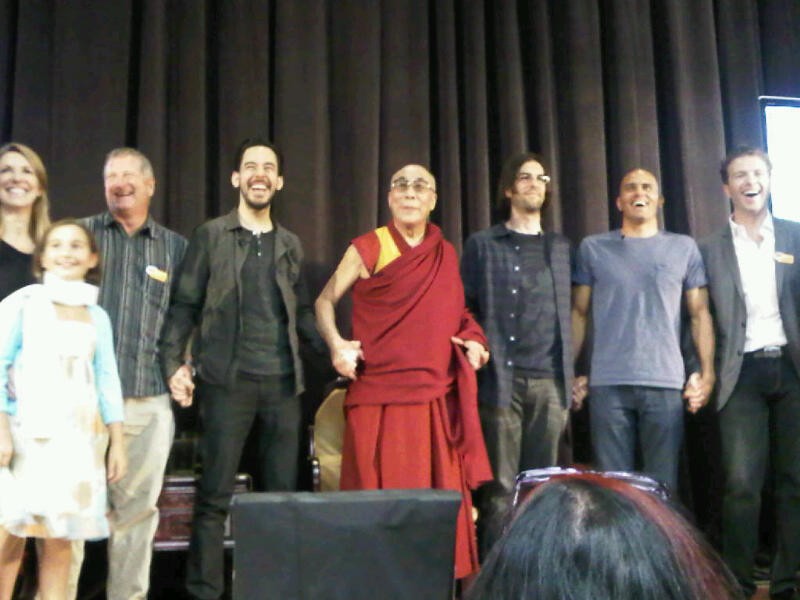
ther platforms part of the new normal). There is much to learn from LP; as much about finding success as avoiding failure: The recent hugging/high-fiving the band didwith a certain elderly monk seems to have slowed that train’s return trip to China, but the point is, Team Linkin spent a good amount of energy building a real presence, and it paid off nicely until things went pear-shaped.
Linkin Park's Mike Shinoda and Rob Bourdon at the 2011PTTOW Summit via lptimes.com
Which is the other point: Real investment in China requires a full-on effort and an outlook that goes far beyond scheduling. Which doesn’t mean bands that want in to China need to drop causes, shut up and play. It means they have to know what the investment in China involves.
So let’s say Radiohead is weibo-ing. Let’s say they get a few zillion more followers. They might well become invested in the country, proving their commitment not to the sales of billions of records but in the healthy development of an industry that is, to put it kindly, still finding its feet. There are two ways to look at the music business in China (like so many other industries): One: It’s a complete mess. Piracy is rampant, censorship is difficult, apathy is widespread. Two: It’s a clean slate. Everything is brand new. Nobody’s been doing anything for very long, so the potential for change is so huge.
Radiohead didn’t have a clean slate upon which to write the rules to their recent releases, but it sure seemed like they did. Imagine what they could do with an actual clean slate.
Let’s be clear: It’s not that Radiohead will be the tide that rises all ships on the storm-ridden and pirate-infested Chinese market. But a real involvement could certainly make others stop and rethink strategy, both inside and outside the country.
…
One yearns to bring this all back to Red Rock, that much-anticipated book now less than three months from international release. One can. Because Radiohead’s earliest imprint in China was made in the wake of Pablo Honey and the song “Anyone Can Play Guitar”. Influential radio DJ Zhang Youdai named his short-lived program (1994-1995) took the name and under its banner brought axemen into the studios of Beijing Radio to teach tunes to listeners. Many a young rocker snuck headphones into their extracurricular classes to listen in on those lessons.
Yang Haisong, the singer of post-punk outfit P.K. 14 and a major figure in yaogun, told me that among his crew, “Anyone Can Play Guitar” was more than just a song. It was their mantra and guiding philosophy. “Grow my hair,” Thom Yorke sang. “I wanna be wanna be wanna be Jim Morrison”. It sounds cheesy, and maybe he was poking fun. But when you find out that yaogunners were longing for the excitement, action and promise of America’s sixties to lift them out of the angst of China’s nineties, and that they believed they found it in rock and roll, it takes on a whole new meaning.
It was more than a rock song: It was the impetus for a life-altering decision, one that separated you from 99.9% of the world as you knew it. You couldn’t just grow your hair until the late nineties; those locks marked you as a rebel of a kind that those of us in rock and roll’s homeland couldn’t imagine.
“I wanna be in a band when I get to heaven,” went the song. When young ‘gunners heard that, they took it to heart, and you can hear it in the best of the music they made.
Since we’re at the beginning, why not start from yaogun’s beginning. Cui Jian kicked off yaogun when he performed “Nothing to My Name” at the Workers’ Stadium — and on nationwide television — in May 1986 (There’s a voice-over, and the action cuts out early, but surely you get the gist):
But what might just be the most entertaining aspect of the whole yaogun clock is that it came amongst the Hundred Stars’ wanna-be “We Are the World” extravaganza, “Let the World be Full of Love”, in which a Cui Jian of a very different kind appears at around 13.05, when he steps to the mic and “sings” words that were never were truer: “The world is changing/It only longs to never change”.


 Under the banner of “The Great Music Debate”, the magazine gathered a dozen and a half members of the music community in a room, threw out some questions and took notes. There were folks from all corners in on the talk: Reps from record labels, festivals and venues; promoters, performers, observers and writers.

 Shanghai, has been hosting awards from their earliest (2007) days with a nice mix of folks nominated and awarded. Midi Productions, those behind the Festival of the same name, decided, in 2009, to give out awards as well; reviews of Midi’s Awards have been mixed (I have been on the Midi jury, and am more often than not disappointed with how things turn out; more on that, I’m sure, eventually).

 Yang Haisong, the singer of post-punk outfit